The Half-life of Software
The half-life of software is the time required for half of the software developed today to disappear from the market. Today that half-life is four years, a number I found by analysing the lifetimes of more than 200 discontinued software products.
We usually design software with an implicit assumption that it will live forever. Or, perhaps, ten or more years, which in our industry is a synonym for "forever." The hard truth is that half of the software you write today will be gone from the market within the next four years.
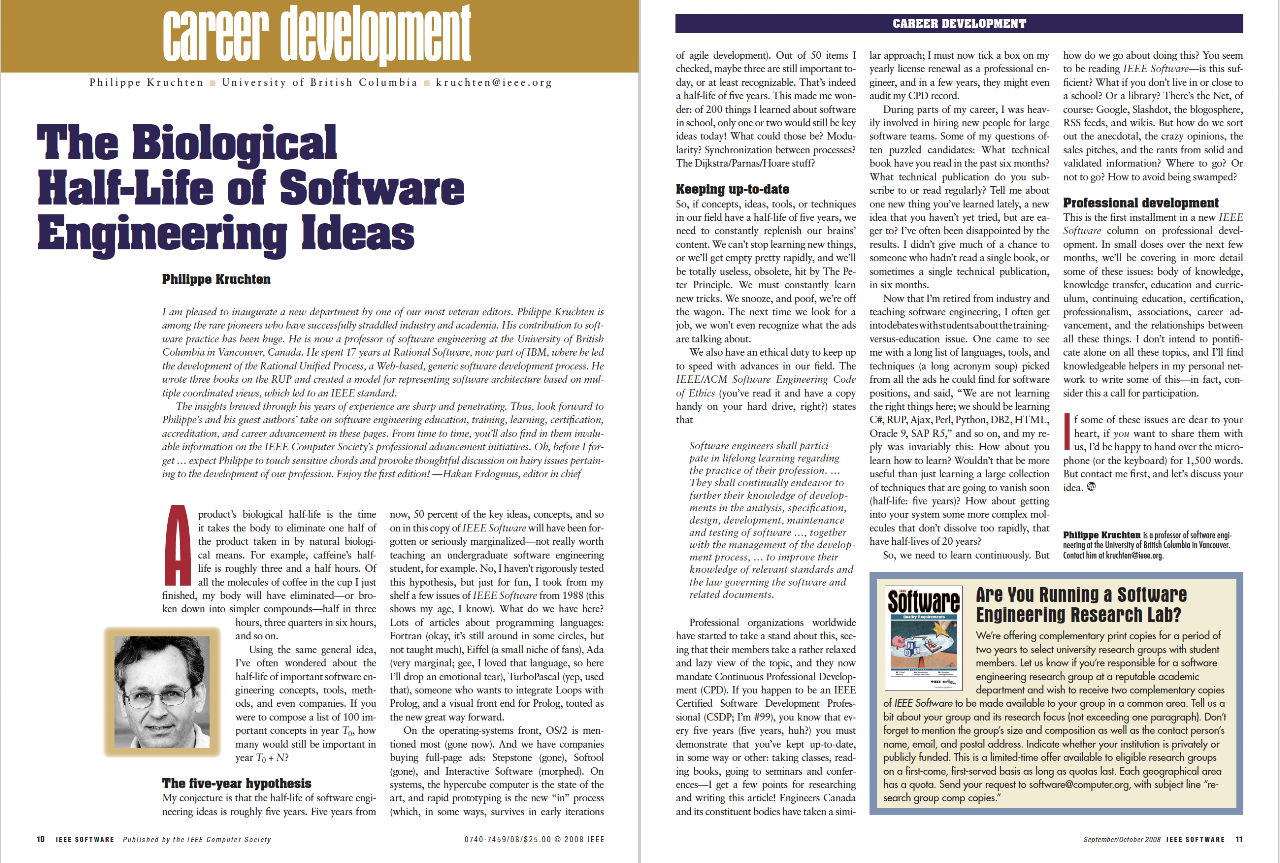
There is an intriguing connection to Kruchten's hypothesis of a roughly five-year half-life of software-engineering ideas: concepts, tools, and methods.
An older IBM study went further still: application programs, on average, have a very short useful life of about fourteen months.
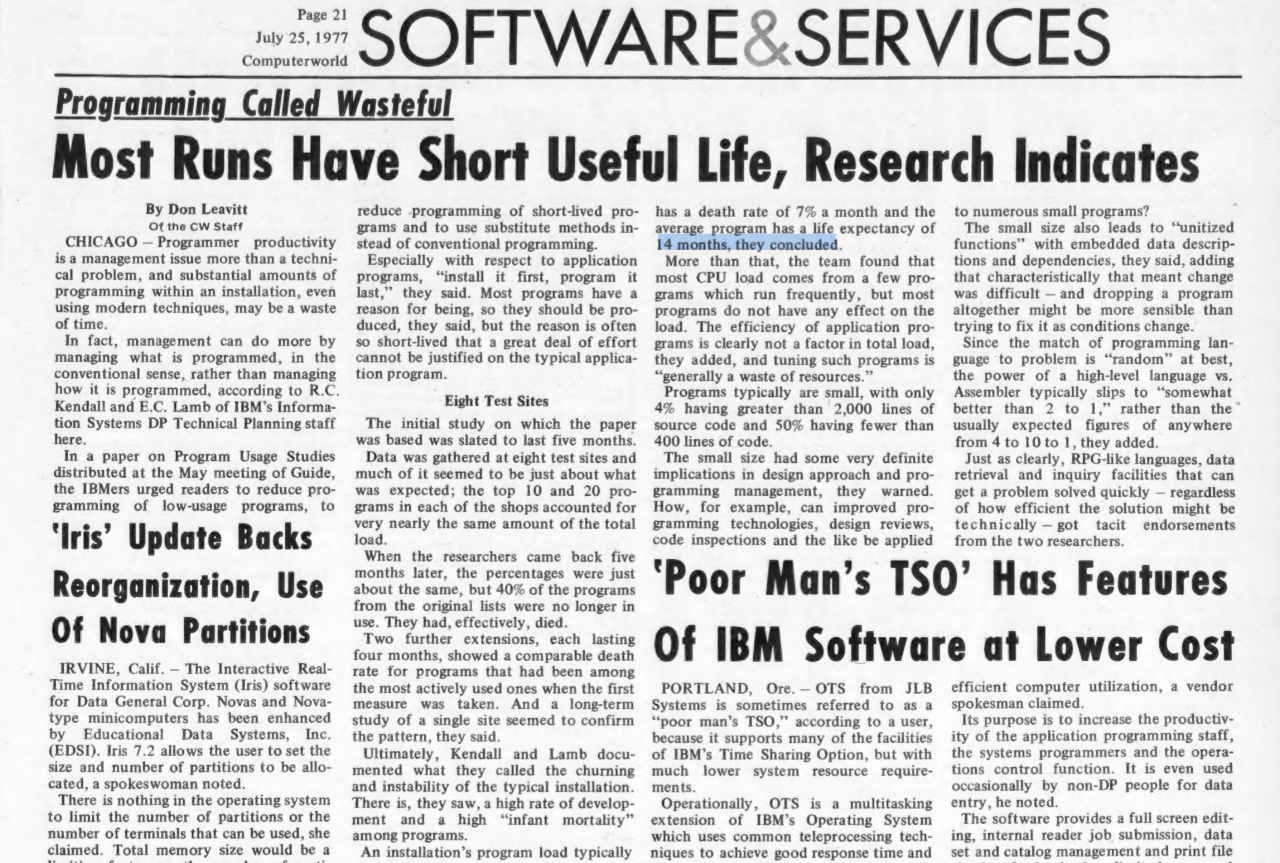
An installation's program load typically has a death rate of 7% a month, and the average program has a life expectancy of 14 months.Don Leavitt, Computerworld, 1977
- Philippe Kruchten. "The Biological Half-Life of Software Engineering Ideas." IEEE Software, 2008.
- Don Leavitt. "Most Runs Have Short Useful Life, Research Indicates." Computerworld, Vol. XI, No. 30, July 25, 1977, p. 21.
- Data sources: Wikipedia, List of Discontinued Software; Killed by Google.